SEO vs AEO: How Search Is Changing (and What It Means for B2B Marketers)
Key takeaways:
Answer Intent, Not Just Keywords - Focus on the questions your buyers are asking, rather than solely targeting search terms.
Structured Content Wins - Use Q&A formats and bullet points (like we did through our every blog article), and concise paragraphs to increase the likelihood of being featured in snippets.
Leverage Schema Markup - Implement FAQ (like ours at the bottom), How-To, and Q&A structured data to help search engines understand your content and display rich results.
Optimize for Voice & Mobile Search – Ensure answers are clear, concise, and conversational, as B2B buyers increasingly use voice search.
Update and Audit Regularly - Keep content accurate and relevant to maintain authority and visibility in answer-driven search results.
Combine with SEO - AEO enhances intent capture and engagement, but works best when paired with a solid SEO foundation for overall visibility.
Traditional Search Engine Optimization (SEO) is still critical, but the rise of Answer Engine Optimization (AEO) (also GEO) is reshaping how B2B companies connect with prospects. No matter if you call it AEO or GEO, the goal is the same: to be the go-to source or the answer AI brings up first, so more people see you in AI-powered searches. For law firms, accounting firms, architecture studios, real estate agencies, industrial manufacturers or other, you name it, understanding the distinction between SEO and AEO is essential to stay competitive in the digital landscape.
This article dives deep into what SEO and AEO are, how they differ, how to implement them effectively, and why B2B marketers must adapt to maintain visibility and generate qualified leads.
What is SEO?
As you for sure already know, Search Engine Optimization (SEO) is the practice of optimizing your website and content to rank higher on search engines like Google for relevant keywords. In B2B contexts, SEO focuses on attracting high-intent buyers, increasing domain authority, and improving organic traffic.
Key SEO elements include:
Keyword research: Identifying high-value search terms your potential clients use. For example, a law firm might target “corporate law services for startups.”
On-page optimization: Crafting content with relevant headings, meta tags, internal linking, and structured data.
Technical SEO: Ensuring fast site speed, mobile responsiveness, and proper indexing to improve search engine crawlability.
Link building: Acquiring high-quality backlinks from industry-relevant sites to boost authority.
SEO in B2B Marketing: For B2B service providers and industrial firms, SEO is about visibility at critical points in the buyer journey. For instance, a firm targeting “financial audit services for manufacturers” needs its content visible when decision-makers research solutions.
What is AEO?
In contrast to SEO, Answer Engine Optimization (AEO), also called GEO (Generative Engine Optimization), focuses on optimizing content to directly answer user queries, often in formats that search engines can display as rich results, snippets, or voice search answers. In other words, it’s speaking with ChatGPT, Claude, or any other AI tool to get answers. You ask, they answer. Unlike traditional SEO, which targets keyword rankings, AEO targets intent-driven answers.
Key AEO elements include:
Content structured for intent: Organizing content in question-and-answer format (as we’re doing it know), FAQs (you can see ours at the bottom), and bullet points (throughout the whole article)
Featured snippet optimization: Creating concise, informative answers that search engines can pull directly.
Schema markup: Using structured data to help search engines understand content context.
Voice search readiness: Optimizing content for conversational queries like “What is the fastest way to process corporate legal contracts?”
AEO in B2B Marketing: B2B buyers increasingly use precise questions when researching vendors. An architecture firm, for example, may see prospects asking, “What are the latest sustainable building regulations in 2025?” Optimizing for these queries ensures your firm appears at the top of results with actionable answers, not just links.
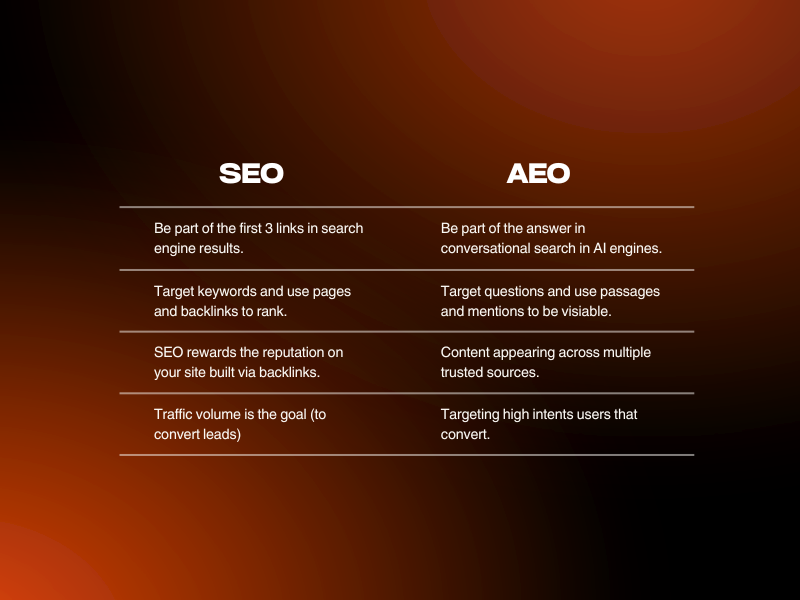
SEO vs AEO: Key Differences
SEO gets prospects to your website; AEO ensures your content answers their questions directly, even before they click through.
How SEO and AEO Are Evolving
AI-Powered Search: Google’s algorithms now prioritize context and intent over exact keywords. This means B2B content must align with buyer questions rather than just keyword stuffing.
Voice Search & Conversational Queries: B2B buyers increasingly use voice assistants to research solutions. Optimizing for long-tail, natural language queries is essential.
Zero-Click Searches: Up to 65% of searches result in no clicks. AEO ensures your company provides the answer directly on the SERP, improving brand recognition even without traffic.
SERP Diversification: Knowledge panels, featured snippets, and “People Also Ask” boxes are now prime real estate. AEO strategies target these placements to increase authority and trust.
How to Implement SEO for B2B Marketing
Advanced Keyword Mapping: Use tools like SEMrush or Ubersuggest to identify industry-specific terms. Prioritize intent-driven keywords such as “industrial compliance consulting for manufacturers.”
Content Hubs: Organize content around pillar pages and topic clusters to demonstrate expertise in your domain.
Technical Audit: Regularly check for crawl errors, mobile performance, and structured data to maintain high search visibility.
Thought Leadership Content: Publish white papers, case studies, and blogs that solve complex industry problems, attracting high-value B2B prospects.
How to Implement AEO for B2B Marketing
Create Q&A-Style Content: Identify common buyer questions through surveys, sales feedback, or tools like AnswerThePublic. Structure content to directly answer these queries.
Schema & Structured Data: Implement FAQ (as mentioned you can see our at the bottom), How-To, and Q&A schema to enable rich snippet eligibility. Key takeaways, a ‘quick overview’ of the most important outcomes of the text, also help AI tools to shape their answers. You might have seen ours at the very top.
Optimize for Voice & Mobile: Ensure answers are concise (40–50 words for featured snippets) and mobile-friendly.
Leverage Case Studies & Practical Examples: Provide actionable insights that answer real-world B2B problems.
Ready to adapt your marketing to the future of search?
HeyOrange team will analyze your website, content structure, and search visibility to identify quick wins and strategic opportunities for better rankings.
Discover how ready your business is for HubSpot. Take our HubSpot Readiness Check to uncover your automation potential and get personalized next steps. It's a 7-question quizz that's done in under 30 seconds.
Map content to buyer journey: SEO drives awareness, AEO accelerates consideration.
Audit content regularly: Ensure answers remain accurate and updated for AEO success.
Align with sales intelligence: Collaborate with sales teams to capture high-intent questions prospects ask.
Monitor SERP features: Track featured snippets, knowledge panels, and other answer-based placements for your keywords.
Why B2B Marketers Must Adapt
Ignoring AEO could mean losing visibility even with strong SEO, especially as buyers increasingly rely on instant answers. Combining SEO and AEO ensures:
Higher brand authority on SERPs.
Increased lead quality due to intent-focused content.
Enhanced customer experience, providing value before the first click.
Competitive advantage in industries where decision-makers demand precise insights.
For modern B2B marketers, SEO and AEO are complementary strategies. SEO builds a foundation for authority and traffic, while AEO captures intent-driven queries and positions your business as the go-to expert.
By understanding the nuances of each approach, implementing structured, intent-based content, and optimizing for both traditional and answer-based search, your firm, whether law, accounting, architecture, real estate, or industrial, can dominate search visibility, drive high-quality leads, and accelerate growth.
Ready to Turn Traffic into Customers?
Unlock the full potential of your business with a tailored inbound strategy that attracts, engages, and converts.
Automation solutions tailored to your business, powered by a small and dedicated team. With our boutique approach, you’ll receive personalized support and strategic guidance. Start your journey today!
.svg)